Your Cart is Empty


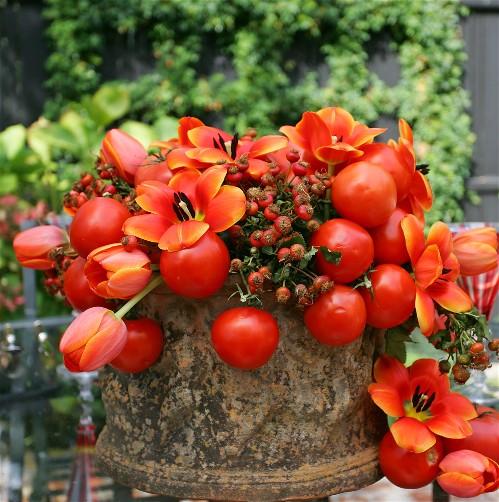
Flower Arranging : "Pre-Arranging fresh flowers"
Flower arrangement by Ron Morgan from In the Company of Flowers.
Working with Fresh Flowers
Pre-Arranging Fresh Flowers
Pre-Arranging Treatment
In order to destroy bacteria from previous plants, scrub plastic buckets and vases with detergent and rinse thoroughly. Rinse again with a mild solution of bleach; one cap full per gallon of water. Bacteria from unclean containers are a primary cause of short-lived arrangements. They clog the stems preventing the life-giving water from reaching the head of the flower and nourishing the complete plant. Plastic storage containers are preferable to metal ones, because the metal can interact negatively with preservatives and shorten plant life.
Fill a clean, plastic storage bucket half full of bottled or purified water and the proper amount of preservatives. It is important to use purified or bottled water, because the chemicals and hard minerals in tap water block the flow of water in the stems. Allow the water to sit for a half hour so trapped air can be released, and so the water can reach room temperature.
Trim off all broken, dying, diseased, wilted or damaged flowers and leaves. This is preparation for arranging as well as for cleaning off bacteria producing plant material. Remove the lower leaves from the stems.
Make the stem ends even, then hold them several inches underwater. Cut 1" from the bottom of the stems. Make sure your cutting tools are sharp. A water droplet will form on the end of the stems and prevent air bubbles from entering and blocking the flow of water when you transfer the flowers to the storage bucket.
Flowers need to hydrate in a preservative solution to replace moisture lost during cutting and handling. Let the flowers stand and balance themselves in the storage bucket. Keep them in a cool, well-ventilated place (never in direct sun) while they drink up the preservative through freshly cut stems. Allow to sit for six hours or so (or overnight) before placing them in their “designer home”. This nourishing treatment step maximizes solution uptake and greatly enhances the life of the flowers.
A florist stores flowers in a special cooler that has a constant temperature, a humidifier and fans to circulate the air and moisture. Home refrigerators are not suitable for storing flowers.
As individual flowers die, remove them to keep the arrangement looking fresh and to direct the energy of the flower to the development of emerging buds. Sometimes, if a flower has wilted, or looks a little “tired”, shorten the stem, remove some of the foliage, and put it in a smaller vase. Avoid getting water on the leaves and flowers.
Special Treatments
Semi-woody stemmed flowers like hydrangeas, clematis, helleborus, poppies etc., exude a sticky sap. The sap pollutes the water and kills the other flowers. The stems need to be cauterized in order to seal in the sap. Immerse the fresh cut stem ends in boiling water for ten seconds, or hold them over a candle flame until the ends are sealed. Water will be absorbed through the cell walls of the stems. Solid woody stems that do not exude sap do not require cauterization. They need to be mashed to maximize water uptake.
Daffodils, narcissus, crocus and hyacinth also exude sap that is poisonous to other flowers. The stems are too fragile to cauterize. They need to be hydrated in separate containers for 6-8 hours before adding them to a bouquet.
Some flowers benefit from total immersion in cool water, if they have been left out of water for a few hours. They drink the moisture through their cell walls and regain their composure. Roses, peonies, lilies, wilted violets, wild flowers and especially tropical flowers rebound stronger than ever with a tepid bath before being placed in a storage container for hydration in a preservative solution.

Tulips that have curled up can be straightened by carefully placing them upright in a tall, straight vase and adding a couple of pennies to the water.
To perk up roses when their heads begin to droop, take them out of the arrangement and place them in a tepid bath for an hour or so. Cut an inch off the stems under water before putting them back in a clean vase.
When using growing plants in an arrangement, submerge the whole plant in tap water to clean the leaves and roots. Then, hydrate them in a preservative solution before adding them to your arrangement.
Taking the time to trim off dying plant material and leaves beneath the water line, cutting the stems under water, and allowing the flowers to hydrate in a preservative solution before arranging them in a vase, will add significantly to the life and beauty of your arrangement.
Helpful Hints for Fresh Flowers
• Scour containers with a plastic pot cleaner, brush or sponge and rinse with a mild solution of chlorine bleach.
• Remove all leaves and foliage below the water line. They decay quickly, have an acrid odor and distract from the design.
• Cut stems under water.
• Cut ends of stems on a slant. Crush the ends of thick stems.
• To change the water in a cut flower arrangement place the vase in a sink or bucket and add purified water until the vase overflows and the water runs clear. The life of the arrangement will be significantly extended by not exposing the stems to air.