Your Cart is Empty


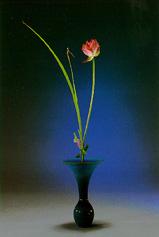
Contemporary Floral Design
The Art of Arranging Flowers Around the World
Part Two
Contemporary Trends in Floral Design
Influences, which have helped, crystallize our present day aesthetics and preferences are the art forms of the past from all parts of the world. Great artists are visionaries. They stand upon the shoulders of the people and show us trends and choices that lie ahead. The people, who create beautiful things for their homes, gifts for others or to bring in income reflect the changing consciousness, values and feelings of civilizations.
Schools of Japanese Flower Arranging
Ikebana, the Japanese word for the art of flower arranging, is more popular today than ever. The word meaning of ikebana is “living flowers”, but a more accurate interpretation would be an ‘arrangement of plant material’. Ikebana strives to convey through symbolism how nature and art relate to daily living. Originally, the first school of ikebana was divided into three styles. The formal Shin style involved an erect line arrangement displayed in a bronze container, sitting on a carved teakwood stand. The Gyo, or semi-formal school, featured flowing, sweeping lines and the use of a variety of containers. And, the So, or informal school, displayed flowers in baskets, bamboo vases and natural wood containers as well as in pottery sitting on bases of bamboo or natural wood. All the schools had one concept in common. They employed three main branches of varying lengths which where used to achieve asymmetrical balance and a three dimensional effect. All three styles symbolically portrayed the relationships between heaven, man and earth.
Styles of Japanese Flower Arranging

Rikka
Rikka means ‘standing flowers’. The designs are large, elegant and magnificent. The basic arrangement of three main stems are the framework or setting for the flowers. They are carefully balanced and often massive in their proportions, An average Rikka measures from three to five times the height or width of the container. Once the length of the primary branch has been decided, the other branches are balanced according to a set pattern of measurements. A completed Rikka is globular in form having great space and dimension.

Nageire
Nageire means to throw or fling. Hence the Nageire Style has a spontaneous, casual feeling. Nageire requires a tall container and employs various artifices to hold the branches in position. The primary branch may be from one to two times the height plus the width of the container. The secondary branch is three quarters the length of the primary branch and the third branch is three fourths as long as the second branch.
Shoka

Classical Shoka arrangements have a linear style and use no more than two varieties of materials. Modern Shokas commonly use three varieties of materials. It is one of the oldest styles of ikebana. The Shoka design contains three principal branches that rise from the mouth of the container as a single unit. The design is devoid of any foliage for a height of three to four inches above the rim of the container. The branches are held in position with a special holder. When flowers are combined with the branches, the branch material is used for the primary and secondary stems. The flowers are used in place of the third stem.

Moribana
The Moribana style is not created for religious ceremonies, nor does it represent any ethical or philosophical symbolism. The arranger is guided by either the container or the material when deciding on the design. The arrangement employs the artistry of asymmetry, creates a feeling of depth and aspires to endow the arrangement with a mood. The Moribana arrangement reminds me of how children play in the sand or dirt and make magical environments.
Bonsai

The word ‘Bonsai’ means, tree-in-a-pot in both the Chinese and Japanese language. It was originally developed in the Orient over 2000 years ago. A tree planted in a small pot becomes a Bonsai after it has been pruned, shaped and coaxed into a desired shape. The art of creating and nurturing a Bonsai is separate from flower arranging, but I included a few words about it because it is so closely related to flower arranging and so widely popular.
Chinese Flower Arranging
Chinese flower arranging includes the use of the strong, erect, highly colored and dominant male element called yang along with the finer, delicately tinted, horizontal or vine-like female element called "ying". Species of plants are usually limited to one or two kinds. Chinese flower arranging suggests a way of perceiving the perfection of life as represented in the balance between contrasting natures. Seasonal plant material is preferred, and each month of the year has its special flowers. Many have symbolic meanings: pine boughs represent wisdom, maturity and nobility, narcissus (the sacred lily) stands for prosperity, good fortune and purity, Bamboo represents longevity, constancy, humility and fidelity, peach blossoms are youth and charm. No one really knows who assigned significance to each flower and plant, but it is written that '‘every plant can well express itself.